

MARKET BRIEFING
Crypto Payment Cards: How Stablecoins Reached $759 Million in Monthly Card Spend
The mechanics, growth and market structure behind the rise of stablecoin-funded payment cards
11 August 2026
Executive summary
Crypto payment cards, which let a cardholder spend stablecoins anywhere a traditional card network is accepted, have moved from a niche curiosity to a genuine, fast-growing payment channel. Monthly spend on tracked crypto card programmes reached $759 million in July 2026, roughly 2.5 times the $306 million recorded a year earlier, and up from less than $1 million when tracking began in October 2023. The number of purchases made with these cards has grown in step, from around 5.2 million to roughly 9.0 million a month over the same period, taking the average transaction size to approximately $86.
Two structural shifts underpin this growth. First, settlement activity has diversified away from Gnosis, the original home of self-custodial crypto cards, towards a broader set of blockchains, with Optimism, Solana and Base now each carrying a meaningful share of volume. Second, the currency mix has moved decisively towards the US dollar: dollar-backed stablecoins, principally USDC and USDT, now account for the overwhelming majority of spend, displacing the euro-backed EURe that dominated in early 2024. Throughout this evolution, one constant has held: almost all tracked programmes settle through Visa's card network rails, meaning the growth of crypto cards has piggybacked on existing payment infrastructure rather than requiring merchants or acquirers to adopt anything new.
This briefing sets out how a crypto card transaction actually works behind the scenes, walks through the growth and composition data, and highlights the market context and caveats that should inform how the figures are read.
1. Introduction
Stablecoins, cryptoassets designed to hold a stable value by referencing a fiat currency such as the US dollar, have historically been used mainly for trading, remittances and holding value onchain. Crypto payment cards extend that utility into everyday spending. A cardholder links a stablecoin balance, either held directly in a self-custodial wallet or deposited with a card issuer, to a physical or virtual card. When that card is used at the point of sale, the stablecoin balance is converted into local fiat currency and the transaction is settled through a conventional card network, most commonly Visa. To the merchant, nothing about the transaction looks unusual: it arrives, is authorised and is settled exactly like any other card payment.
This design choice, converting crypto to fiat behind the scenes rather than asking merchants to accept cryptoassets directly, is the reason crypto cards have been able to scale quickly. It removes the need for merchant education, new point-of-sale hardware or bespoke acquiring relationships. It also means the growth in crypto card spend is, in effect, a growth in the use of existing card network rails to move stablecoin value into the real economy.
2. How a crypto card transaction actually works
The appeal of crypto payment cards lies in what happens away from the point of sale. The diagram below sets out the full path a transaction takes, from a cardholder's stablecoin balance through to the fiat funds landing with a merchant.
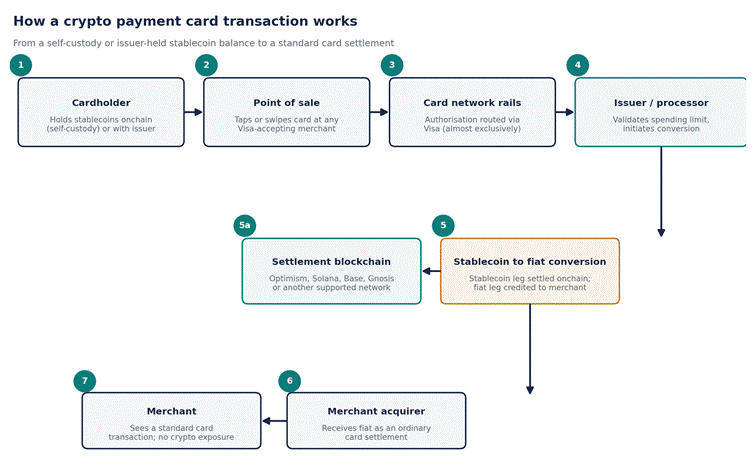
Diagram A: The seven-step flow of a typical crypto payment card transaction, from stablecoin balance to merchant settlement.
Several features of this flow are worth drawing out explicitly.
● No bank account is required. Depending on the programme, a cardholder either deposits stablecoins with a card issuer, who then manages custody and conversion, or holds them directly onchain in a self-custodial wallet linked to the card. This gives users, including those without access to traditional banking, a practical route to holding and spending US dollar-denominated value.
● Conversion happens at, or immediately around, the point of sale. The stablecoin leg of the transaction is settled onchain, while a separate fiat leg is credited to the merchant through the acquiring bank. This dual-leg structure is what allows the transaction to look conventional to everyone downstream of the issuer.
● The settlement blockchain is largely invisible to the cardholder and merchant. It matters for issuers, liquidity providers and infrastructure analysts, but has no bearing on how the payment is experienced at checkout.
● Card network authorisation and settlement rules still apply. Because the transaction rides on Visa's rails, the usual authorisation, chargeback and settlement mechanics of the card network govern the transaction, not a bespoke crypto process.
3. Market growth: volume, purchases and average spend
The clearest signal of adoption is the growth in monthly transaction volume. Monthly crypto payment card volume reached $759 million in July 2026, up roughly 2.5 times from $306 million a year earlier, and a substantial increase from less than $1 million when tracking of this data began in October 2023. These figures reflect onchain activity attributable to card programmes tracked by Paymentscan; for RedotPay, the single largest programme by volume, spending is self-reported by the issuer rather than independently observed onchain, a caveat addressed further in Section 7.
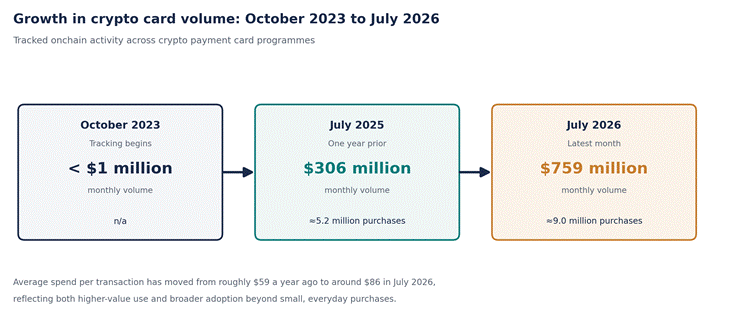
Diagram B: Growth in tracked monthly crypto card volume and purchase count, October 2023 to July 2026.
Purchase counts have grown broadly in line with volume. Nearly 9 million purchases were made using crypto payment cards in July 2026, up from about 5.2 million a year earlier. That puts the average amount spent per transaction at around $86, up from roughly $59 a year prior. The rise in average ticket size suggests crypto cards are increasingly being used for larger or more varied purchases, rather than remaining confined to small, incidental spending.
Metric | July 2025 | July 2026 | Change |
Monthly card volume | $306 million | $759 million | +148% |
Monthly purchase count | ≈5.2 million | ≈9.0 million | +73% |
Average spend per transaction | ≈$59 | ≈$86 | +46% |
Leading settlement chain | Mixed, post-Gnosis transition | Optimism (≈29%) | n/a |
Leading stablecoin | USDC (≈48%) | USDC (≈58%) | +10 pts |
Dominant card network | Visa | Visa | Unchanged |
4. Settlement infrastructure: the shift across blockchains
In early 2024, crypto card spending was concentrated almost entirely on a single blockchain: Gnosis, home of Gnosis Pay, the first Visa card connected directly to a self-custodial wallet. As new card programmes have launched, settlement activity has diversified considerably.
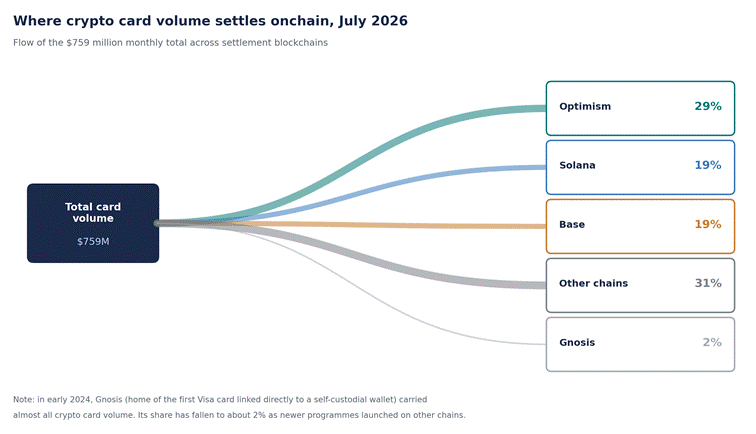
Diagram C: Distribution of July 2026 crypto card volume across settlement blockchains.
As of July 2026, Optimism carries about 29% of crypto card spend volume, with Solana and Base each accounting for roughly 19%. Gnosis, once the dominant settlement layer, has dropped to about 2% of tracked volume. This diversification reflects the entry of new card issuers and programmes, each typically anchored to a particular blockchain ecosystem, rather than a decline in any single network's technical performance. For compliance and risk purposes, it is worth noting that different settlement chains carry different transaction finality characteristics, validator sets and bridge dependencies, which may be relevant when assessing counterparty or operational risk across programmes.
5. Currency composition: the dollarisation of crypto card spend
The currency composition of crypto card spend has shifted just as markedly as the underlying settlement infrastructure. Euro-backed stablecoins once dominated: in early 2024, around 88% of crypto card volume settled in EURe, much of it on Gnosis. As of July 2026, EURe's share has fallen to about 2%.
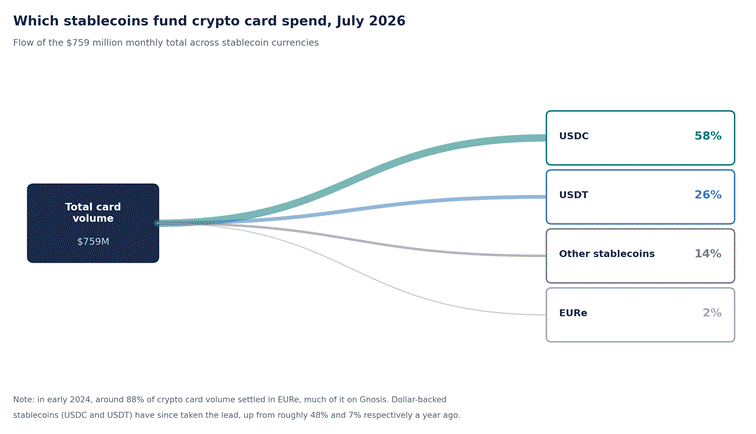
Diagram D: Distribution of July 2026 crypto card volume across stablecoin currencies.
Dollar-backed stablecoins have taken the lead in their place. USDC now handles about 58% of card spending and USDT about 26%, up from roughly 48% and 7% respectively a year earlier. In practical terms, crypto payment card spending now happens overwhelmingly in digital dollars. This has implications beyond the payments market itself: it reinforces the US dollar's role as the reference currency for onchain economic activity, and it means cardholders outside the United States are, in effect, gaining convenient access to dollar-denominated balances through a card product rather than a traditional bank account.
6. Card network rails: the role of Visa
Crypto payment cards remain a small market next to traditional card networks, which process trillions of dollars in volume every month. But the trend is growing as stablecoins make greater inroads into the global financial system, including by piggybacking on existing major card network rails rather than requiring new payment infrastructure.
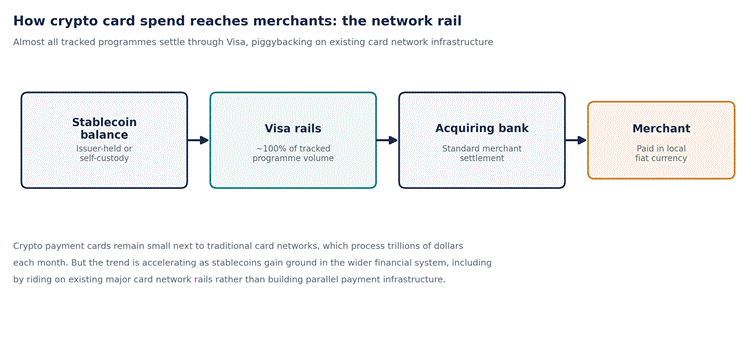
Diagram E: The card network rail connecting a stablecoin balance to a merchant's fiat settlement.
For the tracked programmes, this is happening almost entirely through Visa. That concentration matters for how the market should be assessed: growth in crypto card spend is, at present, closely tied to a single card network's rules, risk appetite and commercial terms for crypto-linked issuing programmes. A change in Visa's approach to this segment, whether commercial or regulatory in origin, would have an outsized effect on the market as it currently stands.
7. Market context, data caveats and outlook
Two points of context are important when interpreting these figures.
● Scale. Crypto payment cards remain small in absolute terms. Trillions of dollars move through traditional card networks each month, against which $759 million in monthly crypto card volume is a rounding error. The significance of the data lies in the rate of growth and the direction of travel, not in the current scale relative to the mainstream payments industry.
● Data provenance. The figures in this briefing reflect onchain activity attributable to card programmes tracked by Paymentscan. One notable exception is RedotPay, the largest programme by volume, for which spending is self-reported by the issuer rather than independently observed onchain. Readers relying on this data for decision-making purposes should treat the RedotPay component with appropriate caution and, where material, seek independent verification.
Crypto payment cards form one part of a broader acceleration in crypto-linked financial activity following the passage of the GENIUS Act, alongside the rapid adoption of stablecoins more generally and the growth of tokenised assets. Taken together, these trends point towards stablecoins becoming an increasingly normal, if still small, component of everyday payments infrastructure, accessed through familiar card rails rather than novel crypto-native payment methods.
8. Considerations for issuers, acquirers and compliance functions
For firms operating in or adjacent to this market, several practical considerations follow from the structure described above.
● Concentration risk. Heavy reliance on a single card network (Visa) and, within settlement infrastructure, a small number of blockchains, represents a concentration that warrants ongoing monitoring as part of any operational resilience or third-party risk assessment.
● Custody model matters. Whether stablecoins are held by the issuer or directly by the cardholder in a self-custodial wallet has materially different implications for consumer protection, safeguarding and insolvency treatment, and should be assessed separately for each programme.
● Data quality varies by source. As the RedotPay example illustrates, not all volume figures in this market are independently verifiable onchain. Any analysis used for regulatory reporting, investment decisions or public communication should clearly distinguish observed data from issuer-reported data.
● Regulatory perimeter. The regulatory treatment of crypto card programmes, spanning payments, e-money and cryptoasset regulation, varies by jurisdiction and continues to evolve. Firms should track developments in their relevant jurisdictions rather than assume a settled position.
9. Conclusion
Crypto payment cards illustrate a broader pattern in how stablecoins are being absorbed into everyday finance: not by replacing existing payment rails, but by using them. Stablecoin balances are converted to fiat currency at the point of sale and routed through conventional card network and acquiring infrastructure, principally Visa, so that the transaction is indistinguishable from an ordinary card payment to the merchant on the other end. On that foundation, monthly spend has grown from under $1 million to $759 million in under three years, settlement activity has diversified across several blockchains, and the currency mix has shifted decisively towards the US dollar. The market remains small relative to traditional card networks, but its growth trajectory and structural reliance on existing rails make it a segment worth continued, and informed, attention.
Source and notes
Underlying volume, purchase count, settlement chain and currency data reflect onchain activity tracked by Paymentscan (paymentscan.xyz), with the exception of RedotPay volume, which is self-reported by the issuer. Figures are as of July 2026 and the twelve months prior, unless otherwise stated. This briefing is prepared for general informational purposes and does not constitute investment, legal or regulatory advice.
DISCLAIMER
Nothing in this report constitutes legal advice, financial advice, investment advice, or a recommendation to adopt, implement, or refrain from any particular course of action. Readers should not rely on this report as a substitute for independent legal, regulatory, tax, financial, or technical advice tailored to their specific circumstances and jurisdiction. The Digital Commonwealth (DCW) accepts no liability for any loss, damage, or consequence arising directly or indirectly from reliance on the contents of this report.
The regulatory landscape for stablecoins and digital assets is evolving rapidly across all jurisdictions referenced herein. Whilst reasonable care has been taken to reflect the state of regulation, legislation, and market practice as at May 2026, this report does not purport to be a comprehensive or definitive statement of the law or regulatory position in any jurisdiction. It may not reflect developments occurring after the date of publication. Readers operating in regulated activities should conduct their own legal and compliance review and seek appropriate professional advice.
References to specific legislation, regulatory proposals, market data, and third-party products or services are included for illustrative and contextual purposes only. The inclusion of any such reference does not constitute endorsement, recommendation, or verification of accuracy. Market data and transaction volume figures are drawn from publicly available sources and are subject to revision.
This report is provided on a confidential basis and is intended solely for the use of the recipient(s) to whom it is addressed. It may not be reproduced, distributed, or disclosed to any third party.
ABOUT DIGITAL COMMONWEALTH LIMITED Digital Commonwealth Limited (DCW) is a specialist advisory and intelligence firm operating at the intersection of digital assets, emerging technology, financial regulation, and cyber risk. DCW provides compliance and risk advisory, governance frameworks, regulatory intelligence publications, and strategic research to financial institutions, technology firms, and regulated entities globally. www.digitalcommonwealth.co.uk | info@digitalcommonwealth.co.uk |
Eric Williamson, Director of Compliance and Risk
© 2026 The Digital Commonwealth Limited. All rights reserved